


**This is a guest post by Thomas E. Hanna from BlogPhoto.tv**
In 1963, Andy Warhol shocked the world.
The pale, slender artist from Pennsylvania had made his name among painters through portrayals of benign, commercialized objects and pop culture icons. Just one year prior, he had released his most famous among these: a 32-canvas collection showing nothing more than Campbell’s soup cans.
Now, he was painting black protestors being set upon by fire hoses and police dogs, overlaid with the red, white, and blue of United States patriotism.
The painting, entitled Race Riot, was as brilliant as it was provocative. As Warhol would later explain in an interview with Gene Swenson, he wanted to demonstrate the way violent imagery affects us. No matter how sick and disturbing the images in media may be, we have become so conditioned to it that it barely registers.
So in 1963, Andy Warhol presented the same media violence to the world in a shockingly new way, challenging our perceptions as he did so.
This is the legacy of brilliant painters. Their paintings do not simply portray images. They tell stories. The best paintings are almost always metaphors.
You, too, are a painter. You, too, are a storyteller. It is simply the tools that differ.
The blog is your canvas. Words are your medium.
And metaphors are your weapon.
The Hidden Power Of Metaphors
I’ll tell you a secret: you are wired for storytelling.
Stories do far more than engage your interest. They create an experience that causes measurable physiological changes in the way your brain and body operate.
In fact, a 2013 study at Berkeley University found that stories actually change the oxytocin in your bloodstream, the chemical responsible for feelings of empathy.
Other neurological studies have looked at the brain itself, finding that stories activate the regions of the brain responsible for sensory experiences: sight, sound, smell, taste, touch. In other words, people that are drawn into a story don’t just hear words. They experience the events described.
As a blogger, metaphors are your doorway into the powerful world of story. If you wish to create an experience for your reader, you need that story. You need powerfully visual writing.
So how do you do that? I’m so glad you asked.
STEP 1: The Concept
 When Andy Warhol painted Race Riot, he knew what he wanted to communicate.
He didn’t come up with a list of possible meanings. He identified a solitary concept and developed his art to convey it.
It is the same with your blogging. Every article you publish needs to be simplified to one major idea. Every sub-point in your post then needs to point back to that concept.
You should be able to communicate your one main idea in less than 10 words. This article, for example, can be summarized as “using metaphor to create a visual experience.”
Seven words. Make sure that yours is just as simple.
STEP 2: The Sketch
 When an artist sets the stage to craft an important work, they begin with a sketch.
For a painter, the sketch starts with a simple idea. That idea is then tweaked, morphed, and expanded until they arrive at a concept that can capture their message . That concept is then developed into an outline before being painted.
Bloggers benefit from the same preparation and brainstorming. For bloggers, it is the metaphor that allows them to create a visual, sensory experience for their reader.
Here is a fun and easy process for developing a strong metaphor.
- Begin with the main idea solidified in step 1.
- Pick a key word, and write it down in the center of a piece of paper.
- Begin mind mapping word associations to that term.
- Identify one or two of the word associations, and further expand them.
- When you find a key idea, hone in on it and develop it.
- Can you overlap that idea with your entire piece? If so, then run with it.
Here is what that process looked like for me in developing the idea for this particular article:
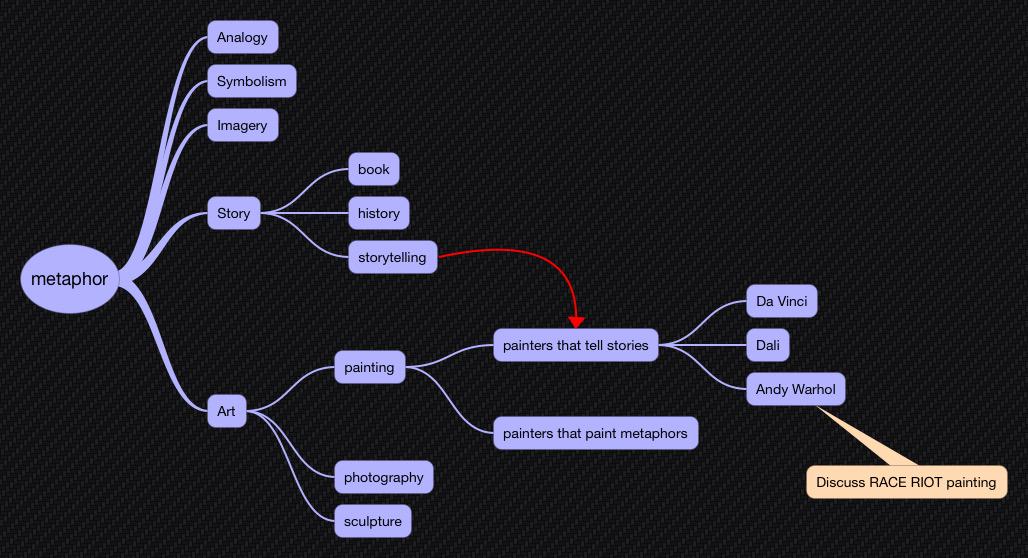
{This mindmap was created with the iPhone app iThoughts}
When my brainstorming session led me to Andy Warhol, I knew I could tell the story of his Race Riot painting as an introduction and then weave the discussion on painting throughout the article.
This last point is important to remember. If you can tie your subheadings to the metaphor you have developed, it strengthens the story and brings consistency to the entire article. It allows you to wrap the elements you are teaching in an engaging narrative.
You’ll also find that this strategy moves you through the first two stages in developing a killer blog post, and it does so in a fun and effective way.
STEP 3: Start Painting
 Once you have a clear metaphor and have determined how you will tie it to the different sections of your article, it is time to pick up your brush and fill your canvas with color.
There are four keys to crafting a visual experience:
➽ Show the story. Remember that you are using a metaphor to move away from analysis and into a visual experience. You need to describe it, to tease it out. Make it part of a larger story. If possible, engage the senses. What does it look like? Sound like? Smell like? Don’t tell your reader. Show your reader.
➽ Be specific. Narrow your field of view. Don’t tell your reader that being a blogger is like being a painter. Tell your reader that blogging is like being a specific painter. Tell them that creating a killer blog post is like Andy Warhol’s painting Race Riot. Then, tell them why. The more specific you can be, the more you can draw a reader in.
➽ Be creative. Don’t limit your metaphor to just one association and leave it at that. Look at how you can open the metaphor up. Find multiple points of contact between it and the topic you are writing about. You wouldn’t just paint with one color, so don’t write with one idea.
➽ Make the connection clear. The worst thing you can do is paint a beautiful picture and then fail to make the overlap between your metaphor and your topic apparent. So spell it out in simple terms. You want your readers to spend their time enjoying your article, not interpreting it.
This process does more than offer a creative approach to writing. It creates an experience for your reader, moving your article from a collection of data to a sensory encounter with highly beneficial content.
Closing Thoughts
When Andy Warhol painted Race Riot in 1963, he unveiled it in Paris and triggered a highly emotional reaction. The elements he chose to include — from the contrast of patriotic colors to the violent media image he depicted — all worked together to present the world with the most powerful political message of Warhol’s life.
50 years later, that painting was sold for over $62 million.
Warhol reminds us that a powerful metaphor leaves a lasting legacy. It begins with a simple idea, but when simple ideas are given shape, they can impact the world.
Your writing begins with a simple concept. The concept becomes a sketch, and then a canvas, and then a story. That story draws its power from the strength of the metaphor that supports it.
Find the metaphor. Prepare the metaphor.
And then, unleash that metaphor upon your readers.
 Thomas E. Hanna is on a mission to rescue remarkable visionaries from internet obscurity. He is the founder of BlogPhoto.tv, where he equips budding entrepreneurs with the tools, resources, and training you need to stand out online.
I am both a writer and a painter, but other than using visual illustrations for scenes in stories, I’ve never quite applied the process of art making to writing blog posts. Refreshing, quite convincing, and very useful. One of the best posts I’ve come across, including the reference to the University of California (Berkeley) study, an article from which even seasoned writers can learn something.
I’m STOKED to hear this post is going to help you channel your artistic talents into your writing! Big ass high five for the love – here’s to crushing it with your blogging!
Wonderful post! As a copywriter, I particularly relate to your advice, “Don’t tell your reader that being a blogger is like being a painter. Tell your reader that blogging is like being a specific painter…”
Copywriting at its best is like painting word pictures, so your sketch metaphor captures the process more than the concept of “outline.” Nice way to write a post that’s not just memorable, but also delivers a memorable message.
High five to that, Cathy! Thomas is the bomb as this tuff…he makes the art of visual writing look easy, so breaking down his process for those of us {ME} that aren’t as eloquent with our words as we are with our visuals is absolutely fantastic. I’m always jelly of you epic writing ninjas. Thanks for the comment love, lady!
Cool! I’m actually slowly incorporating this in other topics I do. Still working on my technique and that flowchart example is definitely a BIG help.
I’ll probably try and do this with my SEO related stuff in the future when I get the hang of it. Hmm…
You and me both, Dennis, but there’s no one better to teach us the 1-2-3 of metaphors than Thomas. High five for the comment love, brotha!
The great thing about writing is that, like everything else, you get better at it the more you do it. The great thing about blogging is that, if you have developed a community that trusts you, you have some freedom to experiment with new techniques without alienating your audience if the quality isn’t as solid.
I’ve seen your blog, Dennis. You have great stuff going on. Don’t be afraid to experiment with new styles to round yourself out as a writer.
There is no blogger I know better than Thomas E. Hanna when it comes to metaphors and beautiful storytelling.
Excellent post, Thomas, and another great post on your blog, Andrea. ?
Thanks Brent!
I really love how your own article is a great example of the point you’re making Thomas. I wonder though, can this be used also for tutorials and showcase-type posts with a bunch of examples? I guess I’m having a hard time picturing how it would work right now, but I guess that means I just need to sit down and start with a mind map huh? ?
Great question, Marianne! I’m all about visuals but I’ve still got a lot to learn about visual writing, that’s why I HAD to have Thomas share his process with us.
Great question Marianne!
Ultimately, the answer is: it depends. Writing is art and, like any art, the willingness to experiment will only led to your improvement overall.
But in general, yes it can. Your showcase examples and even tutorials are ultimately built around your one big idea: how to do “x”. The metaphor doesn’t take away from that, it just finds a way to embed the process in story.
If you look at my article, it was very similar to a tutorial on writing with visual metaphors. It just wrapped that tutorial in story.
EPIC indeed!
I don’t know where you came up with this story about Andy Warhol or related it in your mind to blogging. That is my struggle, finding the universal and interesting bit of history and making the connection.
Thanks to both of you for this slice of badassery.
You and me both, Scott! Thomas makes it look so freakin easy but at least NOW we have a process to follow. I plan to mind map my badass off and see how much I can hone on this side of the visual movement. Big ass high five for the love, bro!
If that’s your struggle Scott, then let me add one other step to help hone that.
You can use the mindmap process to focus in on a concept, and then do a quick bit of research to narrow it to specific topic.
So let me give you an example. If I didn’t know about Andy Warhol, I still could have used the mindmap process to narrow in on “painters that tell stories with their art” or “painters that paint metaphors.”
I could then Google those phrases to identify specific examples of each, and dig into those examples until I find a story worth telling.
The goal isn’t necessarily history, it’s finding that story that is worth telling which can also buttress your article.
Does that help?
Hi folks!
I’m the author of this little piece, and I’ll be popping in and out throughout the next few days to respond to any comments or questions you may have. I’d love to chat with you, so feel free to leave your thoughts and I’ll be happy to reply to them!
Thanks-o-heaps for the EPIC article Thomas, you kinda, almost, most definitely ROCK, brotha! ; )
You’re pretty ok yourself, badass lady. Thanks for the opportunity!